

You.com is a Google search alternative promising better privacy — but something's a bit off
You.com is a Google search culling promising better privacy — but something's a scrap off

Withal another new search engine, You.com, has debuted on the internet promising to preserve user privacy better than big bad Google. But for a privacy-minded venture, it seems to be kind of intrusive.
"You lot.com is sparking a movement to take back the internet and give people control of the information they eat so they can alive more thoughtful digital lives gratuitous from manipulation," said Richard Socher, You.com CEO and co-founder, in an announcement today virtually the availability of the public beta (Nov. ix).
- Robinhood data breach hits 7 one thousand thousand customers — what to do now
- The best internet security suites
- Plus: Google Pixel 6 — this killer characteristic puts the iPhone 13 to shame
"With you lot.com, nosotros're fostering a much more open interface that people can contribute to — not just with likes, upvotes, and engagement — only with the co-cosmos of apps and content in an environment of trust, facts, and kindness."
Socher has a Stanford doctorate in informatics and until recently was working on artificial intelligence and natural-linguistic communication processing for Salesforce, and Salesforce caput honcho Marc Benioff is named as Y'all.com's lead investor. (The company has raised $twenty million so far.)
The company promises that it "never sells personal information, nor does it ever track users around the internet," and "has committed to never offer targeted privacy-invading ads."
Name, email address and browser extension
So we were a little taken aback when we tried to use You.com — and were promptly told that nosotros had to install a Chrome extension first.
Yikes! Knowing what we do about how badly Chrome extensions tin be abused and how much data they tin collect, we advise having as few extensions enabled as possible.
OK, how about "search.yous.com"? Nope, got a 404 in that location. The other privacy-minded search engine that debuted in the past couple of months, Brave Search, lets you utilize it with no strings attached at "search.brave.com."
But it turns out you can add together Yous.com as the default search engine on almost browsers, which doesn't raise any privacy red flags. (Here's a folio with instructions for most major browsers.)
Anyway, we took You.com for a spin. Searching for "fish," we got a nice-looking grid of results in rounded-square tiles, perfect for mobile screens. The page looks very dissimilar from the text-heavy list interface y'all go from most search engines. Instead, it looks like what nosotros'd accept seen if Apple had always come upward with its own search engine.
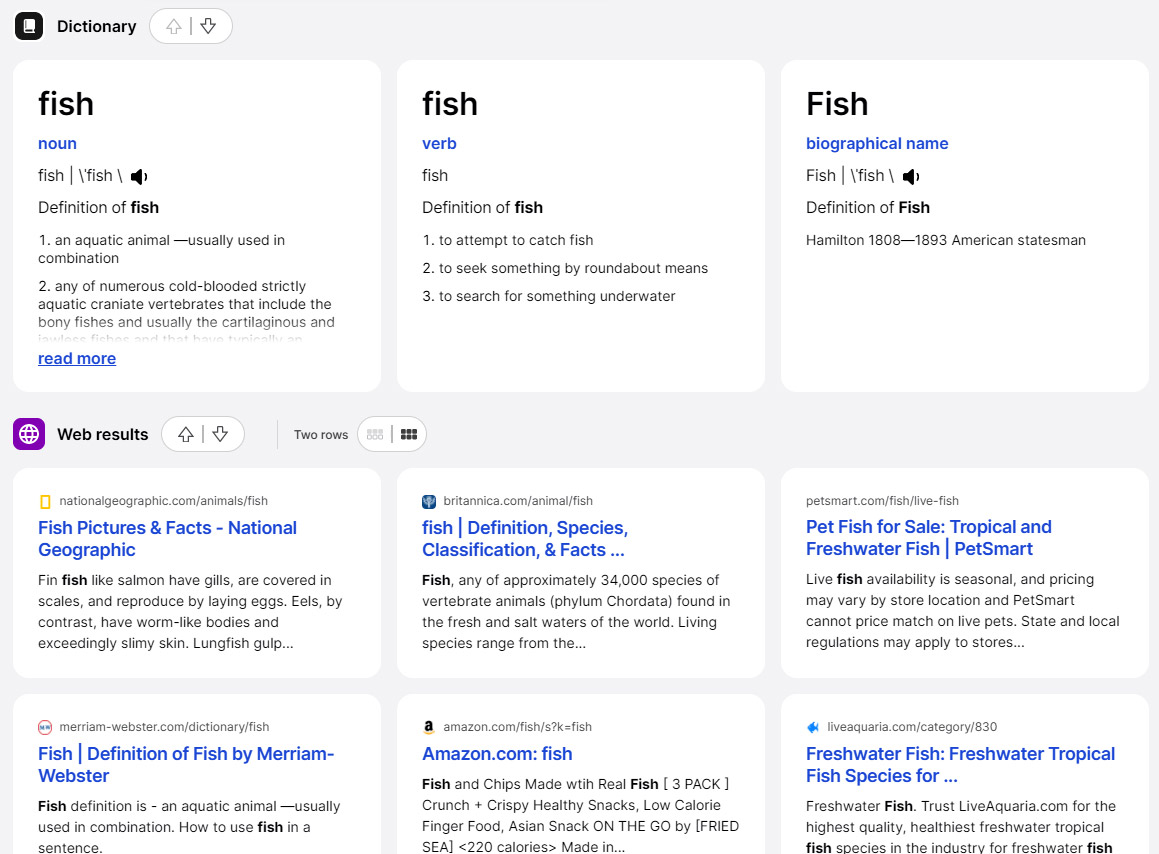
Dictionary definitions led the results, followed by spider web-search results that were nearly identical to Bing'due south results. News stories were next, followed by a Wikipedia link that got its ain row. (Google, Brave Search and the truly privacy-minded DuckDuckGo all led with Wikipedia.) We didn't see any ads.
You.com says its results are partly based on user feedback, and that you can re-rank the results you lot get. We tried doing so and were taken immediately to a screen that asked us to create a You.com user business relationship and provide our full proper noun and email accost. So much for total privacy.
In fact, people searching for things online may non be You.com's actual clients.
Speaking to VentureBeat, Socher said that "our new platform will enable companies to contribute their most useful actual content to that outset page, and — if users like it — they tin accept an action right then and there." (Thanks to Gizmodo's Sam Rutherford for pointing us to that.)
A TechCrunch piece said that You lot.com plans to "concentrate on circuitous consumer purchases," which implies that Yous.com may plan to brand some money through affiliate links.
Notwithstanding, it's not totally clear what You lot.com's business model is yet, and Socher wouldn't tell VentureBeat or TechCrunch what information technology might be. (VentureBeat did glean that You lot.com has most 30 employees.) Simply Benioff and a few venture-uppercase firms are going to expect something back for their investment.
We've reached out to You.com with a few questions, and we will update this story when we receive a reply.

Source: https://www.tomsguide.com/news/you-com-search-engine-debuts
Posted by: tindlepecto1992.blogspot.com
0 Response to "You.com is a Google search alternative promising better privacy — but something's a bit off"
Post a Comment